The Market Full of Misleading Claims
Basement waterproofing is one of the home improvement categories with the highest level of misleading marketing. Products and services are sold with vague claims about ‘waterproofing’ and ‘moisture protection’ that obscure fundamental differences in what each approach actually addresses. A homeowner who purchases interior waterproofing to solve an exterior water management problem hasn’t waterproofed their basement — they’ve managed the symptoms of a problem that continues to affect their foundation.
Understanding the actual source of basement moisture, and what each category of solution addresses, is the starting point for any basement moisture decision.
Three Sources of Basement Moisture: They Need Different Solutions
Interior humidity condensation: warm, humid air enters the basement and condenses on the cooler concrete walls and floor. This appears as moisture on wall surfaces or as rust on metal objects. Solution: dehumidification and air sealing of interior openings. This is not a waterproofing problem; waterproofing solutions don’t address it.
Seepage through cracks: water under hydrostatic pressure finds cracks and penetrations in the foundation wall and seeps through. This appears as wet patches corresponding to visible cracks, or water entering at the wall-floor junction. Solution: crack injection from inside (for isolated cracks) or exterior excavation and waterproofing membrane (for systematic seepage). Interior drain tile systems manage this water after it enters rather than preventing entry.
Surface water entry: rainwater that pools at the foundation or saturates soil adjacent to the foundation infiltrates through the full wall surface or from below the footing. This appears as widespread wall seepage or floor moisture following rain events. Solution: exterior grading correction, proper gutter discharge management, exterior waterproofing membrane and drain tile at the footing.
Interior vs. Exterior Waterproofing: The Fundamental Difference
Exterior waterproofing addresses moisture at its source — preventing water from reaching the foundation wall by applying a waterproofing membrane to the outside of the foundation and installing drain tile at the footing level to direct water away from the structure. This is the most effective approach because it stops water before it enters the building envelope, protecting the foundation itself from ongoing moisture exposure.
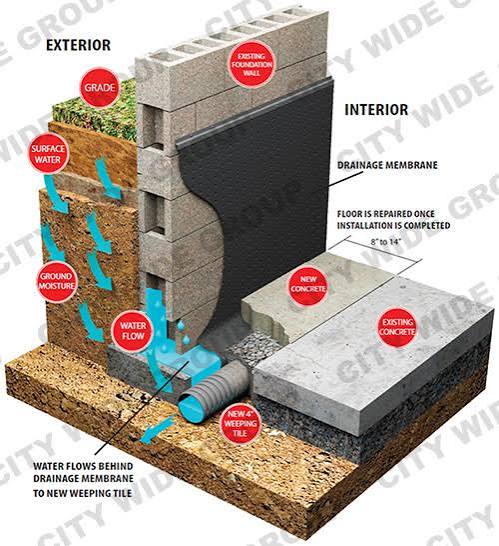
Interior waterproofing systems (interior drain tile, sump pump, and vapor barriers on interior walls) don’t prevent water from entering the foundation — they collect and redirect water that has already entered. The foundation wall continues to be exposed to moisture; the difference is that the water is managed before it reaches your basement floor rather than pooling there.
Grading and Gutters: The First Thing to Fix
Before any waterproofing investment, assess and correct the two most common causes of basement moisture that are entirely solvable without excavation or interior systems. Grading: the soil around the foundation should slope away from the house at a minimum of 6 inches of drop over the first 10 feet. Soil that slopes toward the house directs rainwater and snowmelt directly to the foundation.
Gutter discharge: downspouts that discharge at the foundation wall — even into splash blocks — deposit the entire roof’s water collection adjacent to the foundation. Extending downspout discharge to a minimum of 6 feet from the foundation (preferably via underground drain pipe to daylight or a pop-up emitter) eliminates this concentrated water source. Many ‘basement waterproofing’ problems are solved entirely by these two corrections without any interior work or excavation.
The Sump Pump: What It Does and What It Doesn’t
A sump pump collects water that has entered the basement (through an interior drain tile system or through direct seepage to the sump pit) and pumps it away from the building. It’s an essential component of interior water management systems and in homes with persistent high water table conditions. It doesn’t waterproof anything — it’s a water removal device, not a water exclusion device.
The critical sump pump maintenance requirements that are consistently neglected: test the pump quarterly by pouring water into the pit to verify it activates and pumps correctly, check the discharge line is clear (ice blockage in winter is a common failure cause), and plan for power outage scenarios. A battery backup sump pump or a water-powered backup pump ensures the system functions during the storms — which are precisely when power outages occur and when the pump is most needed.