The Luxury That’s More Accessible Than It Sounds
Radiant floor heating — a system that warms a floor surface from below, heating the room through radiant energy rather than forced air — is consistently rated by homeowners who have it as one of the features they’d never give up. Walking barefoot on a warm tile floor in winter is a genuinely different sensory experience from any other heating method, and the even, draft-free heat distribution is noticeably more comfortable than forced-air systems.
The common assumption that radiant floor heating is prohibitively expensive applies primarily to hydronic (hot water) systems in new construction. Electric mat systems installed under tile in renovation contexts are significantly more accessible in both cost and installation complexity.
Two Systems: Hydronic vs. Electric
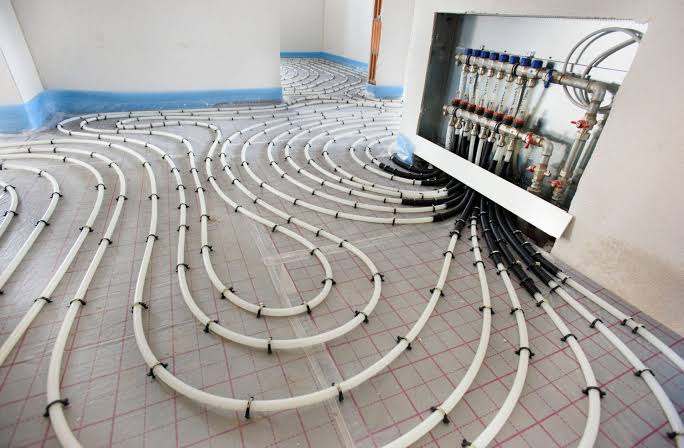
Hydronic radiant floor heating circulates warm water through a network of PEX tubing embedded in the floor structure. It’s the most energy-efficient option for whole-home heating and the preferred system for new construction or full gut renovations where the floor can be opened. It requires a boiler or water heater to heat the water, a manifold to distribute it through the loops, and a pump system. Installation cost is high — typically $6–$15 per square foot — but operating costs are lower than forced-air systems for equivalent heat output.
Electric radiant heating uses resistance heating mats or cables installed under the finished floor surface. Installation is far simpler — the mat unrolls over the subfloor or existing tile, connects to a thermostat, and is covered by the finish floor material. Per square foot installation cost is $8–$15 including labor. Operating costs are higher than hydronic but comparable to electric baseboard heating, and for supplemental heating in bathrooms and kitchen floors specifically, the comfort benefit relative to operating cost is excellent.
Compatible Flooring: What Works Over Radiant Heat
Not all flooring materials are appropriate for installation over radiant heat systems. Tile and stone are the ideal materials — they conduct heat efficiently and are unaffected by temperature cycling. Luxury vinyl plank (LVP) is compatible with low-temperature electric radiant systems when the specific product is rated for use over radiant heat — verify this specification before purchase.
Solid hardwood is generally not recommended over radiant heat — the temperature cycling causes expansion and contraction that creates gapping and potential cupping. Engineered hardwood with a thick veneer layer is more stable and can be installed over low-temperature radiant systems, but requires careful humidity control. Carpet over radiant heat works but insulates the heat from the room, reducing efficiency significantly — most of the heat stays in the floor pad rather than entering the room.
Thermostat Control and Programming
Radiant floor systems in bathrooms and kitchens perform best with programmable thermostats that run the system only during occupancy hours. A bathroom floor that’s warm during the morning routine and evening bath — but not heated during the work day when the bathroom is empty — uses energy efficiently while delivering the comfort benefit when it matters.
Smart thermostats with occupancy sensing or schedule programming (available for $60–$150) provide this control without manual adjustment. The operating cost of a well-programmed bathroom floor heating system is typically $5–$15 per month during heating season — a reasonable cost for the comfort it provides in a room where cold tile is a daily discomfort.
The Renovation Window: When Installation Makes Economic Sense
Adding radiant heat to an existing room is most cost-effective during a floor replacement or renovation that’s happening for other reasons. If you’re retiling a bathroom anyway, adding an electric mat under the new tile adds $200–$600 in materials and a few hours of installation — a small increment on an already open floor.
Retrofitting radiant heat into an existing floor without disturbing it is generally not practical — either the floor must be opened from above or the subfloor replaced. Planning radiant heat during any scheduled floor renovation captures most of the benefit at a fraction of the standalone installation cost.