The Most Hazardous Flooring Surface in Any Home
Stairs are statistically the most dangerous floor surface in residential buildings — responsible for approximately 12,000 deaths and over a million emergency room visits annually in the United States. The flooring material, nosing design, and surface finish on stairs affect slip resistance, visual contrast at step edges, and the consequences when someone does lose their footing. These are not just aesthetic decisions.
Most stair flooring decisions are made on the basis of appearance and cost, with safety characteristics considered only vaguely. Understanding the specific safety features that matter — and how different materials address them — produces better stair flooring choices.
Nosing: The Most Important Safety Detail
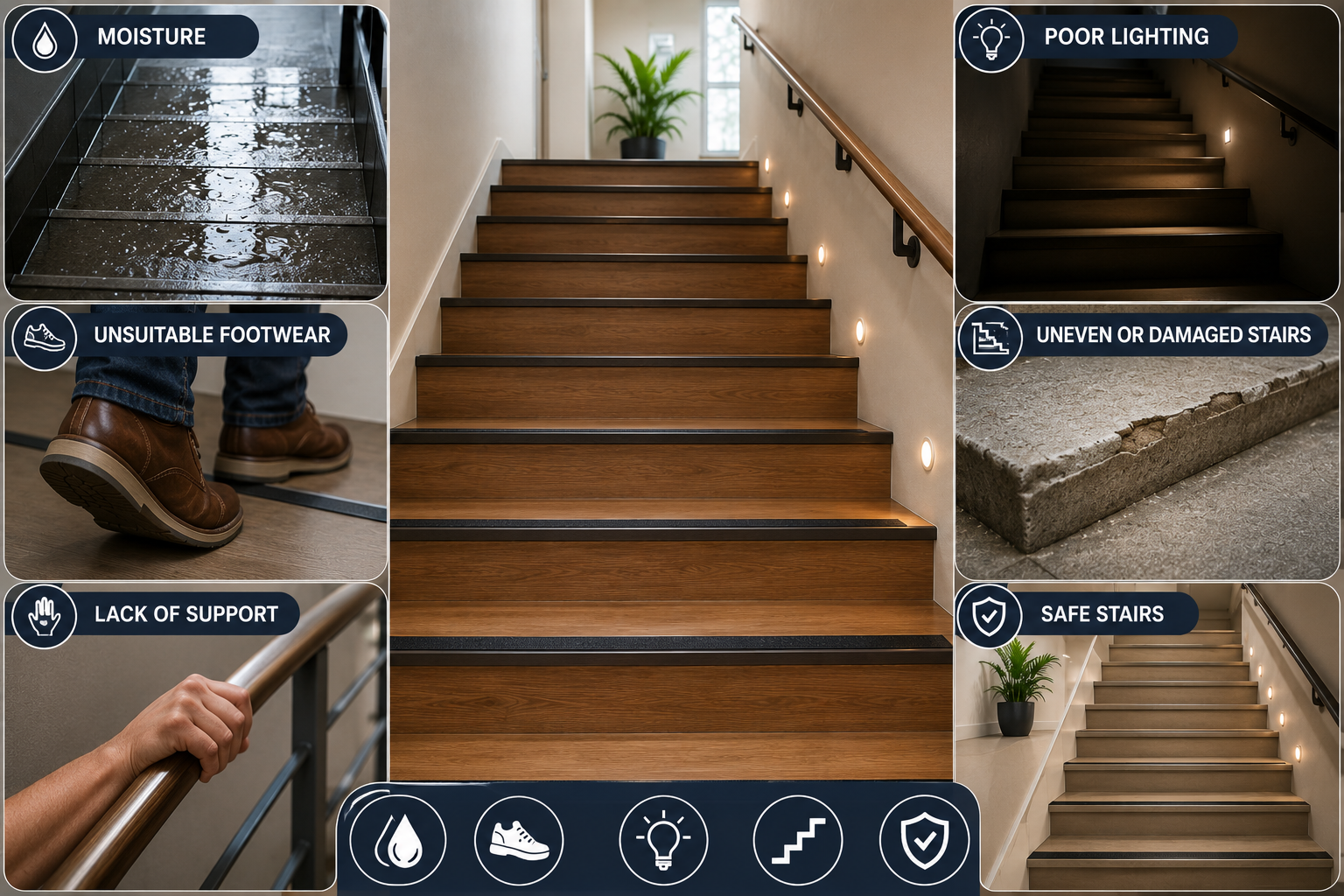
The stair nosing — the front edge of each tread that overhangs the riser below — is where most stair falls begin. A nosing that’s visually indistinct from the tread surface, that has a slippery finish, or that creates a lip the toe catches on contributes to falls that a well-designed nosing prevents.
Effective nosing design: a clear visual contrast between the nosing and the tread surface (particularly important in low-light conditions and for people with low vision), a rounded or beveled edge profile that the foot slides off rather than catching on if contact is made, and a slip-resistant finish or material on the nosing surface. Building codes in most jurisdictions specify minimum nosing projection (the overhang distance) and maximum nosing radius — specifications that exist because their violation has been associated with injuries.
Hardwood Stairs: Beautiful and Demanding
Hardwood stair treads are visually desirable and present specific safety challenges that carpet-covered stairs don’t. A sanded and finished hardwood tread with a gloss polyurethane finish is among the most slippery residential flooring surfaces available, particularly when socks are involved. The practical mitigations: use a satin or matte finish rather than gloss (measurably more slip-resistant under dry conditions), apply a non-slip additive to the finish coat, or install a tread runner (a carpeted strip down the center of the stair) that provides traction while framing the wood aesthetically.
Stair tread carpet runners provide the most significant traction improvement over bare hardwood — the transition from a wood-only stair to a carpeted runner stair is a measurable safety improvement, not just an aesthetic choice.
Carpet on Stairs: The Maintenance and Replacement Reality
Wall-to-wall carpet on stairs is the most traction-friendly stair surface available and the most demanding to maintain. The nose of each tread — the highest-traffic point on a carpeted stair — wears significantly faster than the riser and the back of the tread. On a full-width carpet installation, the worn nosing is visible across the entire stair width and creates a safety concern as the carpet face yarn degrades to the backing.
Carpet runners on stairs (rather than full-width carpet) allow inspection and replacement of individual tread sections as they wear, rather than requiring full-stair replacement when the high-wear nosing area degrades. Quality stair runners secured with stair rods (the traditional installation method) can also be lifted and shifted periodically to even out wear across the runner length — significantly extending useful life.
Lighting: The Safety Variable That Flooring Can’t Substitute For
No flooring material compensates for inadequate stair lighting. A well-lit stair with a slippery surface is safer than a carpeted stair in darkness — the ability to see each tread edge clearly is the primary fall-prevention factor for most stair falls, which occur when foot placement is miscalculated rather than when the foot slips on a surface that was clearly seen.
Stair lighting best practices: consistent illumination along the full stair run without bright spots and dark spots that create visual adaptation problems, lighting positioned to create visual contrast at each tread edge (the nosing should be clearly visible from above as the foot descends), and a light switch at both the top and bottom of the stair so neither end is navigated in darkness while reaching for the switch. These are stair safety fundamentals that building codes require in new construction and that older homes frequently lack.