
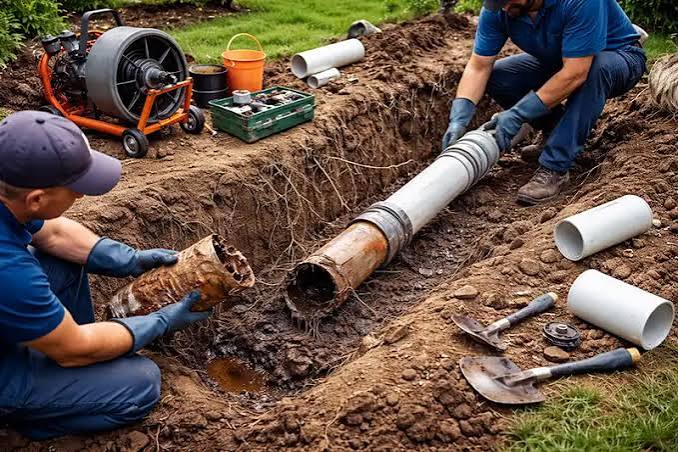
The Plumbing Problem Nobody Thinks About Until It’s Catastrophic
The sewer line — the pipe that carries all of a home’s wastewater from the building to the municipal sewer main or septic system — is the one piece of residential plumbing most homeowners never think about until it fails. When a sewer line fails, the consequences are immediate and severe: sewage backing up into the lowest drains in the home, complete loss of plumbing usability until the line is cleared or repaired, and potential contamination of the home’s interior.
The expense of emergency sewer repair ranges from $1,500 for a simple rooter clearing to $15,000–$30,000 for full sewer line replacement. Identifying developing problems before complete failure allows planned repair at lower cost and without the emergency service premiums.
Warning Signs That Deserve Immediate Investigation
Multiple slow drains throughout the house simultaneously — particularly when they correlate with each other (flushing the toilet makes the shower gurgle) — point to a problem in the shared drain line downstream of where these fixtures join. This is a different problem from individual slow drains caused by localized clogs.
Sewage smell in the yard, particularly along the path where the sewer line runs from the house to the street, can indicate a line break that’s allowing sewage to saturate the soil above the break. Unusually lush, green grass following the same path — even during dry periods — is the same signal: sewage is fertilizing the grass above a leaking line. These are not slow-developing concerns; they warrant immediate professional camera inspection.
The Camera Inspection: What You Get and What It Tells You
A sewer line camera inspection ($150–$400 for most residential lines) inserts a waterproof camera through a cleanout access into the sewer line and provides real-time video of the interior pipe condition. The inspector can identify: root intrusion (roots entering through joints or cracks), pipe offset (where two sections have shifted out of alignment), bellying (a low section where solids accumulate), cracks and fractures, tuberculation (buildup of mineral deposits on pipe walls), and general pipe condition.
Request a video recording of the inspection. A legitimate inspection company provides this as standard; some charge extra. The recording is documentation of baseline condition that’s useful for negotiation if you’re buying a home and useful for tracking whether a developing problem is worsening between inspections.
Repair Options: Spot Repair vs. Full Replacement vs. Lining
When a camera inspection reveals a specific problem at a specific location — a single root intrusion point, an offset at one joint — a spot repair (excavating to that location and repairing or replacing the affected section) is the most cost-effective approach. This avoids the expense of full-line replacement for a localized problem.
Pipe lining (CIPP — cured-in-place pipe lining) is a trenchless approach that inserts a resin-impregnated liner through the existing pipe, inflates it against the pipe wall, and cures in place. This creates a new pipe within the old pipe without excavation, preserving landscaping, driveways, and hardscaping above. It’s appropriate when the pipe has widespread deterioration but is still structurally intact enough to support the lining process. Full replacement is necessary when the pipe has collapsed sections or is too deteriorated to support lining.
Tree Root Intrusion: The Most Common Sewer Line Problem
Tree roots are the most common cause of residential sewer line problems — they seek water and enter through any crack, joint gap, or imperfection in the pipe. Once inside, they grow and expand, eventually blocking flow completely or causing pipe damage from the expansion pressure.
The temporary solution is rooter service — mechanically cutting roots from inside the pipe. This clears the blockage but doesn’t address the root path into the pipe; roots regrow within 1–3 years. The permanent solution is either lining the pipe (which seals the entry points) or replacing the pipe sections where root entry is occurring. Copper sulfate root-killing treatments applied through the toilet do slow root growth and can extend the interval between rooter service, but they don’t address existing root infiltration and shouldn’t replace inspection and proper remediation.